


Social Interaction Model in Public Space (SIMPS)
Welcome to the Social Interaction Model in Public Space (SIMPS) project! In an increasingly digital world, the importance of face-to-face interactions in public spaces cannot be overstated. Public transport hubs, such as bus stops and train stations, serve as vital points of connection for individuals from diverse backgrounds. However, many commuters often find themselves isolated, absorbed in their smartphones, and disengaged from the social environment around them.
The SIMPS project aims to address this challenge by developing a comprehensive simulation model that enhances social interactions among strangers in public waiting spaces. By identifying key attributes that influence how individuals interact, the model seeks to create a more engaging and user-friendly public transport experience.
Through this initiative, we aspire to foster a sense of community and connection among commuters, ultimately contributing to improved user satisfaction and a more vibrant public transport culture. Join us on this journey to transform public waiting spaces into dynamic environments that encourage meaningful social exchanges.
OBJECTIVES
-
To acquire attributes that would contribute to how public transport users would interact with one another
-
To design a model that is able to determine how public transport users would interact with one another based on acquired attributes
-
To evaluate the model by verifying with professionals and validating with a simple controlled experiment
METHODOLOGY
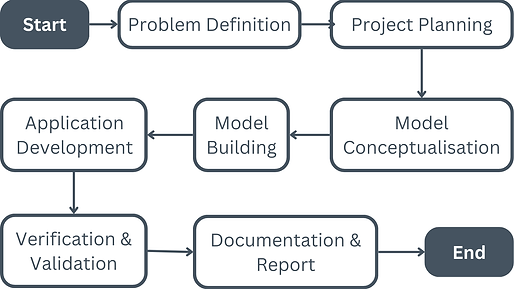
Figure 1: SIMPS Methodology Flow
-
Tackling the first objective can be seen in both the problem definition and project planning where comprehensive literature review on related topics were done to identify what variables that would come into play in this model
-
Building the model for the second objective starts with the conceptualisation of the model through relationship statements to understand how each variable influences one another. The conceptual model is then built into mathematical equations that would then be implemented into MATLAB/Octave and Python to integrate it into a system
-
Application development was optional in this case as no specific objective needed a prototype to be built. However, to show the model off, a simple prototype was built.
-
Mathematical verification and user validation of the model was conducted to tackle the third and final objective
-
A comprehensive report in the form of an article has been created and will be attached at the end of this page.
COMPUTATIONAL MODELS
.png)
Figure 2: SIMPS Computational Models
What you see above this paragraph is the terrifying reality that is computational models; it is all mathematics. What many people don't see is how mathematics allows us to define many functions of this world. For this project, we have looked into the functions that would explain real life human emotion dynamics relatively accurately. As seen above, there are 8 equations that make up the computational model of this project where 3 of them can be grouped under "Dynamic Emotion". Each of these variables are interconnected in some way and a simple map can be seen below:
.png)
Figure 3: Agent Process
In figure 3, the computational models represented by the coloured nodes can be seen with their respective connections. All of the nodes that are outside of the agent process area are agent inputs (except Decision Model, DM) where the value of these data will vary from agent to agent. Now in a simulation, lets say of 5 people, you will have 5 of these agent processes running and feeding into DM to then decide on what content to show. This is essentially the core of this project as without this, mimicking human behaviour and emotions will be near impossible.
However, you must be wondering by now, what is DM? Now, DM is a decision algorithm that will decide on what content to display depending on it's inputs (agent behaviour). To see what DM really is, let's look at Figure 4:

Figure 4: SIMPS Decision Algorithm
Stage 1
In short, the figure describes the flow of the decision algorithm in finding what content would be best to display to encourage strangers to interact. The first if-statement or check as I like to say is to check if there are 2 or more willing to interact agents and at least one ready to interact agent. The idea here is that if there is a room full of people who would not like to interact with another living human being, then there will be no point in finding any content that is specific since no one is going to talk anyways.
However, given that the criteria is met, a new check will be run which is the language check to see what languages do the willing agents speak as a language barrier would be detrimental to social interaction. Once that check ahs been made, a check on what interest and hobbies align will be done. The main thing we want to see here is that someone who is ready to interact has at least 1 similar interest or hobby with a willing to interact agent. Having a common ground or common topic to talk around greatly boosts the chances of a social interaction beginning.
In the event that a are no similar interest or hobbies, a check on cultural similarity (specifically religion) will be made. Depending on the religion, the current cultural festivals (if currently happening) will be selected as the video to be displayed. Eg: Muslims will be given a fasting video close to the month of Ramdhan, Christians will be given more snowy, family oriented and warm content when it is closing into christmas?.
Stage 2
Stage 3